Pantry Inventory Basics: Knowing What You Have
A pantry inventory can be as light as a running-low list on the door or as full as a written count by zone. Compare three levels, see what each costs in effort and pick the one you will keep up.
Simple Ideas for a Better Organized Pantry
Practical ideas for sorting, shelving, containers and zones, so you can see what you have in your pantry and find it quickly.
New to organizing a pantry? Read these four guides in order, from the first sort-out to shelves, zones and containers.
A plain starting point for a messy pantry: what an organized pantry really is, the four ideas every tidy shelf relies on, why containers come last and a small first session you can finish in under an hour.
The full pantry method in ten ordered steps, from emptying and wiping the shelves to sorting, measuring, assigning zones by height, buying only what fits and labeling, with a shelf-height table to guide placement.
What a pantry zone is, the zones most households end up with, five steps for choosing your own and a table of good shelf positions, so every group of food has one fixed place to go back to.
How to choose pantry containers as a system: measure the shelf first, pick shapes that use it, compare materials and lids, and size each container to the package you normally buy. Includes an honest note on what containers cannot do.
The groundwork: emptying the shelves, sorting what you have and setting up an order you can keep.
A pantry inventory can be as light as a running-low list on the door or as full as a written count by zone. Compare three levels, see what each costs in effort and pick the one you will keep up.
Three small habits keep an organized pantry organized: a careful unpack, a short tidy before the main grocery trip and a seasonal review. Here is what each one involves, plus a simple checklist.
Ten common setup mistakes that make an organized pantry fall apart, why each one causes trouble, and a small fix for each that does not mean starting again.
The full pantry method in ten ordered steps, from emptying and wiping the shelves to sorting, measuring, assigning zones by height, buying only what fits and labeling, with a shelf-height table to guide placement.
What goes on which shelf, and ways to use shelf height and depth so nothing gets lost at the back.
Food you cannot see gets rebought or wasted. Work through these fixes in order of effort: clearing, single rows, stepped heights, clear bins, labels and light.
A plain guide to the common shelf organizers: what each one is, the problem it solves and where it fails, with a summary table and a measuring checklist.
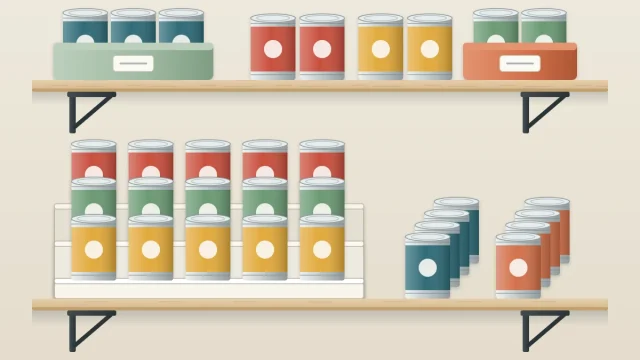
How to sort cans by type, choose between rows, risers, sloped racks and bins, keep older cans in front, and check condition as you go so duplicates stop piling up.
Jars, bins, baskets and labels: what each one is useful for and when you can do without it.
Baskets and bins help when they group loose items into one pull-out unit, and hurt when they become a catch-all. Compare five types, learn how to measure and choose, and how to fill and label them.
Glass jars show you what you have and wash clean, but they are heavy, breakable and round. See which dry goods suit them, how to choose sizes and jar types, and where jars belong on the shelf.
Which pantry items actually need a label, what to write on it, where to place it so it can be read, and a step-by-step plan for labeling a pantry in one session.
How to choose pantry containers as a system: measure the shelf first, pick shapes that use it, compare materials and lids, and size each container to the package you normally buy. Includes an honest note on what containers cannot do.
Ideas for a single cabinet, a narrow closet or a few shelves where every inch counts.
No pantry closet? Six steps to set up one or two kitchen cabinets for food: choosing the cabinets, measuring, assigning shelves and fitting bins that pull out.
How to arrange a tall slim cupboard or a pull-out pantry unit: one category per shelf, stacking upward, loading by height and weight, and making the top shelf usable.
How to make a small pantry closet or cupboard work: decide what earns a place, use the height inside each shelf, pack containers tightly and buy to fit the space.
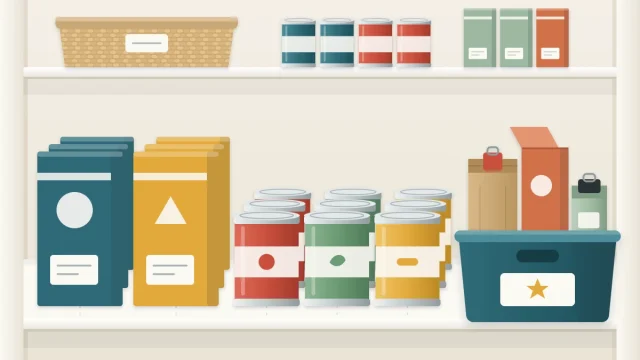
Arranging dry goods, cans, snacks and bulk buys so the older items get used first.
Sort your spices into five groups, pick a display that shows every name, choose one order and give refill bags a bin of their own. A practical setup for spices kept in a pantry or food cabinet.
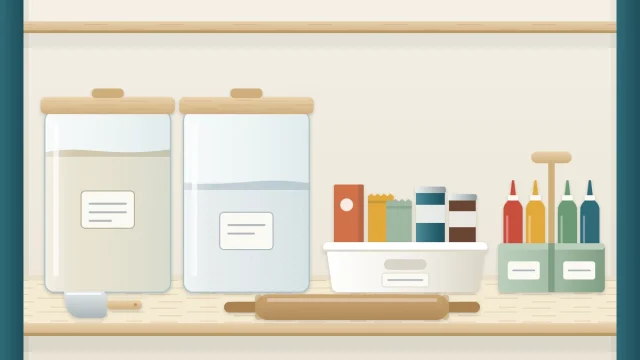
Bring flours, sugars, leaveners and decorations into one baking zone: how to sort them into sub-groups, what storage suits each, and where the zone should sit.
Where to read what the date phrases on packages mean, and how to set up rows, racks and a use-first bin so the oldest package is always the one you reach for.
Two workable ways to store flour, rice, pasta, grains and beans, how to group and place them on the shelf, and where to look up how long each one keeps.
A two-day schedule for redoing a pantry from start to finish: what to prepare in the week before, what to do in each block of the weekend and how to tell when each task is done.
Which pantry staples are worth pouring into containers, which are better left in the package, and a six-step method that keeps the package date, cooking directions and ingredient panel with the food.
A decision guide for the unwanted pile after a pantry clear-out: sort it into four groups, then donate, give away, use up, compost or discard each one, and note what to stop buying.
A pantry that fills up again after every clear-out usually has a buying problem, not a tidying one. Here are nine common causes, the sign of each and a small habit that counters it.
Spare food clutters a pantry when it is mixed with everyday items. Learn the one-open rule, four places to keep extras, how to set a ceiling per item and a quick restocking routine.
Sort your spices into five groups, pick a display that shows every name, choose one order and give refill bags a bin of their own. A practical setup for spices kept in a pantry or food cabinet.
Pick a category to see every pantry guide filed under it.
Follow the step-by-step guide to work through one shelf at a time, or open Tutorials to see every guide on the site in one list.