Organizing Dry Goods: Flour, Rice, Pasta, Grains and Beans
Two workable ways to store flour, rice, pasta, grains and beans, how to group and place them on the shelf, and where to look up how long each one keeps.
Flour, rice, pasta, grains and beans are the backbone of most pantries, and they are also the foods most likely to end up slumped on their sides, half open and hidden behind one another. Organizing dry goods is mostly a matter of making soft packages stand up, telling look-alike foods apart and keeping the everyday ones within easy reach.
None of that requires a wall of matching containers. Some dry goods are easier to manage once they are poured into something rigid, and others are perfectly fine in the bag they came in. Both routes are covered below, along with where each group belongs on the shelf and where to look when you want to know how long something keeps.
What counts as dry goods
Here, dry goods means the shelf-stable staples you cook from. They fall into five loose families, and sorting them this way is the first step:
- Flours and sugars: all-purpose, bread and whole-grain flours, cornmeal, and granulated, brown and powdered sugar.
- Rice and other grains: white and brown rice, quinoa, barley, couscous and bulgur.
- Pasta: long shapes, short shapes and noodles.
- Dried beans and lentils: beans, chickpeas, split peas and lentils.
- Oats and cereals: rolled oats, granola and boxed cereal.
If you bake often, flours and sugars may sit better with the rest of your baking things. The guide to organizing baking supplies as one zone covers that arrangement.
Why dry goods are awkward to store
Cans and jars stand in rows without help. Dry goods do not, for three reasons.
- Soft bags slump. A paper or plastic bag has no shape of its own once it is opened, so it leans, slides and ends up lying flat under something else.
- Half-used packages multiply. A folded-over bag takes nearly as much shelf as a full one, and when you cannot see it you open a second.
- Many of them look alike. Two white flours, three white sugars and several kinds of white rice are hard to tell apart once the printed part of the bag is rolled down.
Option one: keep the original package
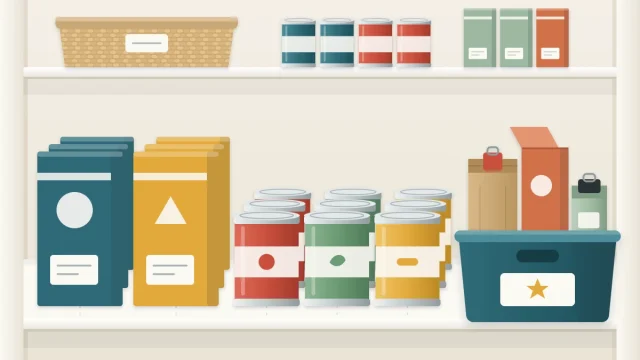
The simplest method costs almost nothing. Fold the top of each opened bag down, close it with a bag clip, and stand the bags upright in an open bin, filed front to back like folders. Use one bin per family, so the rice bin never holds lentils.
The advantages are real. The package date, the cooking directions and the ingredient and allergen information stay with the food, because the label never leaves it. There is nothing to wash and nothing to buy beyond clips and a bin with straight sides.
The drawbacks: paper bags tear, and you cannot see how much is left without lifting each bag out. This method suits foods you buy occasionally, small quantities, and anything with cooking instructions you would otherwise have to copy.
Option two: transfer to containers
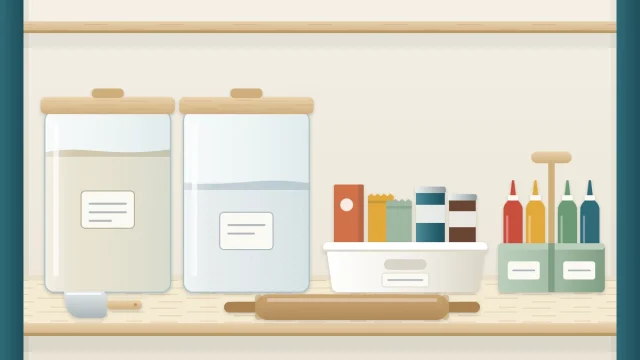
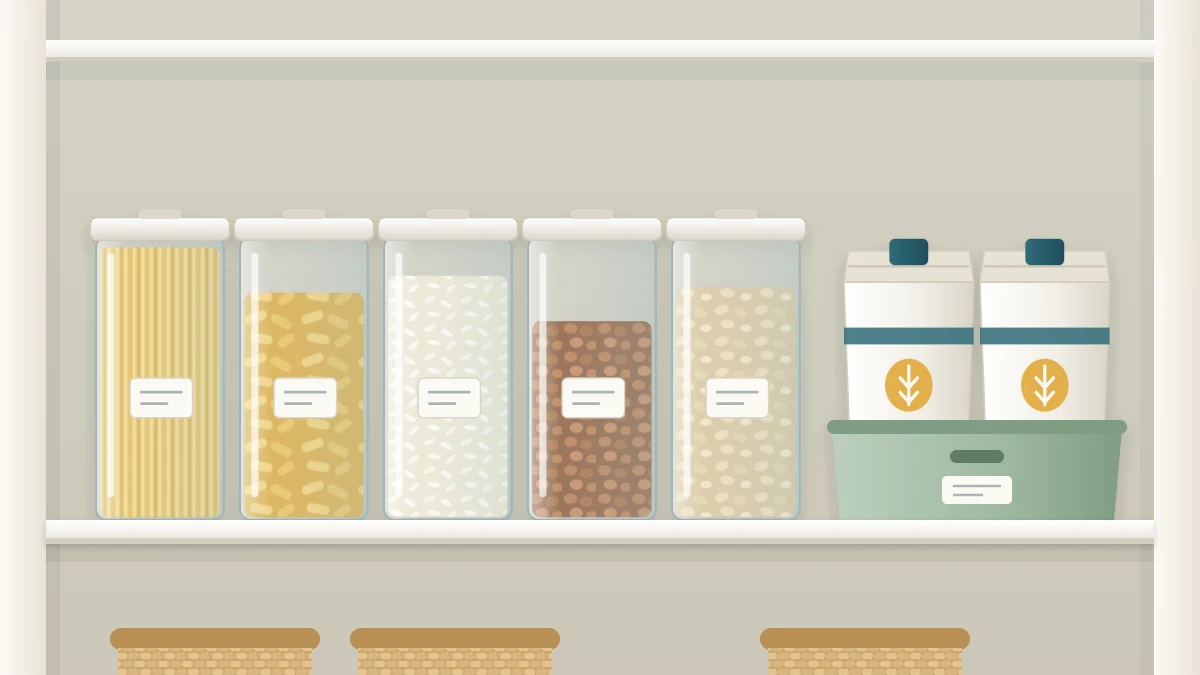
To decant is to pour food from its package into a container. It suits the staples you buy again and again in soft packaging, such as flour, sugar, rice, oats and your everyday pasta shape. A rigid container stacks, pours cleanly and shows the level inside, and a tight-fitting lid helps keep out moisture and pantry insects and contains spills.
The costs are money, washing and the loss of the package unless you copy what is printed on it. The guide to decanting dry goods the right way walks through the steps, and the guide to choosing pantry storage containers explains how to match sizes to your shelf and to the packages you normally buy.

Good to know
A container is an organizing tool. It does not change how long food keeps; that depends on the food, the date on its package and the conditions it is stored in.
Most pantries mix the two methods, food by food:
| Dry good | Usual problem | What often works |
|---|---|---|
| Everyday flour and sugar | Bags tear and dust the shelf | Wide-mouth container that takes a measuring cup |
| Specialty flours | Small amounts, used rarely | Original bag, clipped, upright in a bin |
| Rice and small grains | Bags slump and spill | Container with a pouring opening |
| Long pasta | Boxes split, strands scatter | Tall container, or boxes laid flat in a bin |
| Dried beans and lentils | Many small look-alike bags | One bin of clipped bags, or small containers |
| Oats and cereal | Tall boxes, half empty | Pour-spout container sized to one box |
Group by type, then by how often you use it
Once every package stands, give each family its own zone, meaning a stretch of shelf that holds that group and nothing else. Within the zone, let frequency decide the position. The rice you cook twice a week goes at eye level in front; the barley you use in winter can sit behind it or a shelf higher.
Keep backstock, the unopened spares of foods you already have open, away from the working packages. Large bags of flour or rice are heavy, so their place is a low shelf or a crate on the floor, never overhead. When the open package runs out, the spare moves up to replace it.
Label the look-alikes
Dry goods are the strongest case for labels in the whole pantry. Bread flour and all-purpose flour are indistinguishable in a clear container, and so are granulated sugar and salt at a glance. Write the plain name on the front and add the package date. If you keep foods in their bags, turn the printed side forward.
Storage conditions and how long things keep
As the FDA’s page on storing food safely describes in general terms, pantry foods belong somewhere cool and dry, away from the stove and other sources of heat.
How long each item keeps depends on the food, so this guide gives no figures. Look the item up in the FoodKeeper tool on FoodSafety.gov and read the date on the package. Whole-grain flours and nuts are often stored cold; check FoodKeeper or the package for those rather than assuming the pantry shelf is right. For the shelf habit that makes older packages get used before newer ones, see the guide to date labels and rotation.
Small habits that keep the shelf in order
- Keep a scoop inside a container only if it stays completely dry.
- Finish one package before opening the next, and do not pour new food on top of old.
- Wipe up spilled flour, sugar and grains when they happen.
Frequently asked questions
Do I have to put dry goods into containers?
No. Opened bags that are folded down, clipped and stood upright in a bin stay tidy and keep their label, date and cooking directions with them. Containers are worth the effort mainly for staples you buy repeatedly in soft packaging, where stacking and seeing the level inside make a real difference.
Where should heavy bags of flour and rice go?
Low. Large bags are heavy and awkward, so a bottom shelf or a sturdy crate on the pantry floor is the usual place for spares, with one open package or container of each at eye level. Check that any shelf you load with bulk bags is used within its stated load rating.
How long do flour, rice and dried beans keep in the pantry?
It depends on the food and on how it is stored, so this site does not give figures. Read the date on the package and look the item up in the FoodKeeper tool on FoodSafety.gov, which lists storage guidance food by food, including items that are often stored cold.