
Why Different Types of Hanging Succulents Are Taking Over Home Decor
The different types of hanging succulents you’ll most commonly find are:
- **String of Pearls** – round bead-like leaves, trails up to 36 inches
- Burro’s Tail (Sedum morganianum) – plump overlapping leaves, trails up to 4 feet
- String of Hearts (Ceropegia woodii) – heart-shaped leaves, can reach 12 feet at maturity
- String of Bananas (Senecio radicans) – banana-shaped leaves, faster-growing than String of Pearls
- String of Dolphins (Senecio peregrinus) – leaves shaped like leaping dolphins
- Ruby Necklace (Othonna capensis) – purple-red stems with yellow daisy-like flowers
- Rat Tail Cactus (Aporocactus flagelliformis) – whip-like spiny stems, up to 4 feet long
- Monkey’s Tail (Hildewintera colademononis) – woolly white-spined stems, dangles after 2 feet
- Calico Kitten (Crassula pellucida variegata) – tiny heart-shaped variegated leaves
- Christmas Cactus (Schlumbergera) – flat segmented stems with vibrant blooms
Hanging succulents are popular for one simple reason: they look stunning without demanding much from you.
They store water in their leaves, so they tolerate the occasional missed watering. They trail naturally over pot edges, filling vertical space that most plants ignore. And they come in a wild range of shapes — from pearl-like spheres to dolphin-shaped leaves to woolly cactus tails.
Whether you have a sunny south-facing window or a bright spot on a shaded balcony, there’s a trailing succulent that fits your space.
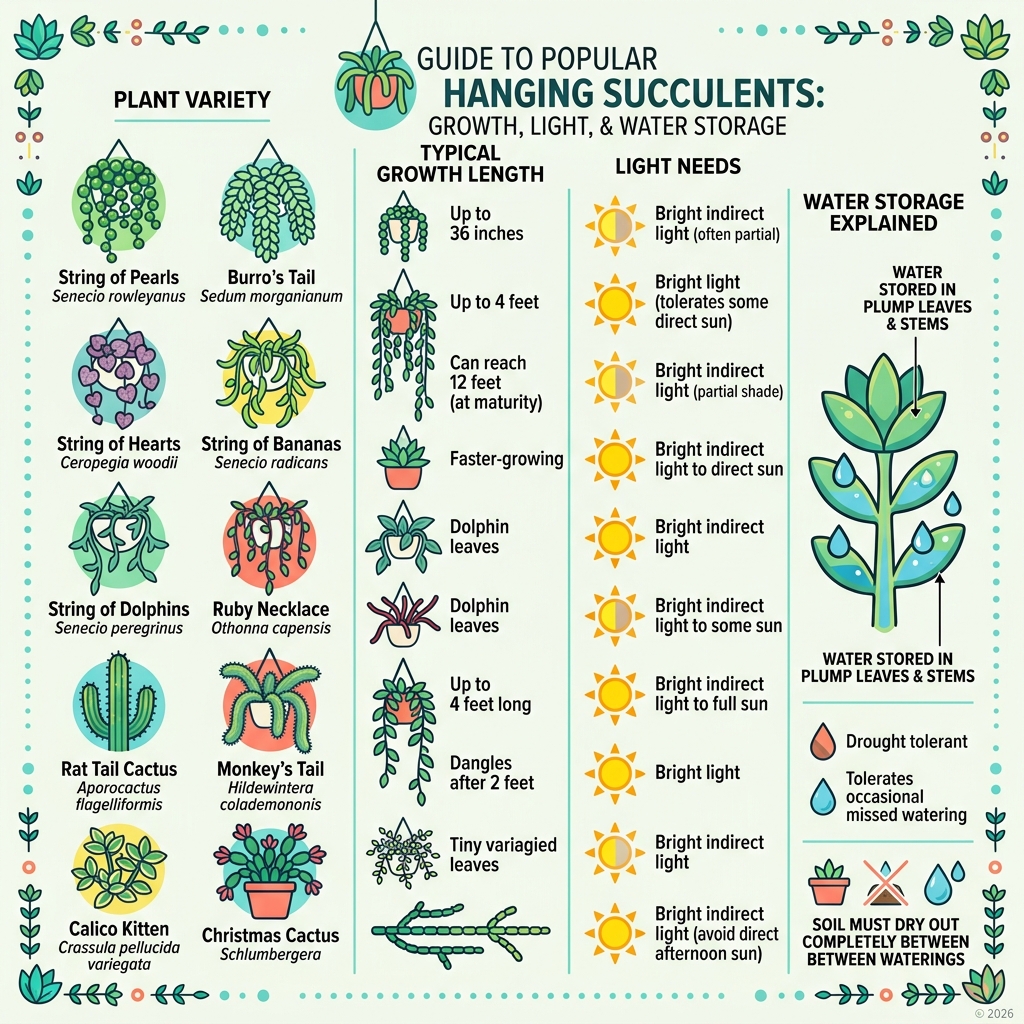
Most Popular Different Types of Hanging Succulents
When we talk about the most popular different types of hanging succulents, we are looking at plants that have captured the hearts of indoor gardeners worldwide. These varieties are beloved for their dramatic silhouettes and relatively easy-going nature.

String of Pearls (Senecio rowleyanus)
The String of Pearls is perhaps the most iconic of all trailing succulents. Its pea-shaped leaves are more than just cute; they feature a tiny transparent “window” strip that helps the plant maximize photosynthesis. While these pearls are stunning, they are also delicate. Their stems can reach lengths of 36 inches, but they are prone to breaking if handled roughly. It’s a plant that thrives on bright, indirect light and a strict “soak and dry” watering routine.
Burro’s Tail (Sedum morganianum)
If you want a “living waterfall” effect, the Burro’s Tail (or Donkey’s Tail) is your best friend. Its heavy, overlapping blue-green leaves are covered in a powdery coating called farina, which protects them from the sun. These trailing stems can grow up to 4 feet long at maturity. A quick tip from us: place this one in a spot where it won’t be bumped, as the leaves drop at the slightest touch!
String of Hearts (Ceropegia woodii)
The String of Hearts is a romantic addition to any room. Its dainty, heart-shaped leaves are often variegated with silver and purple. This plant is surprisingly tough because it grows from underground tubers that store water. While many sources list it as a medium trailer, a mature plant can actually exceed 12 feet in length if given enough time and the right conditions.
String of Bananas (Senecio radicans)
For those who find the String of Pearls a bit too finicky, the String of Bananas is a fantastic alternative. It grows much faster and is generally hardier. Its leaves look exactly like miniature green bananas, and the vines can easily reach 36 inches or more. It’s a great choice for filling out a hanging basket quickly.
| Succulent Name | Max Trailing Length | Ideal Light |
|---|---|---|
| String of Pearls | 3 feet | Bright Indirect |
| Burro’s Tail | 4 feet | Bright Indirect / Partial Sun |
| String of Hearts | 12 feet | Bright Indirect |
| String of Bananas | 3-6 feet | Bright Indirect / Full Sun |
| String of Dolphins | 3 feet | Bright Indirect |
Identifying Different Types of Hanging Succulents by Growth Habit
Identifying different types of hanging succulents often comes down to observing their growth habit. Some, like the Senecio varieties, feature thin, vining stems that look like strings. Others, like Sedum, have thick, cascading foliage that feels heavy and lush.
When you’re looking for best-indoor-hanging-plants-a-guide-for-urban-jungles, it’s important to consider whether you want a “spiller” that cascades straight down or a “creeper” that might spread across a shelf before hanging. The leaf shape is also a major giveaway—from the perfectly round spheres of the String of Pearls to the flat, segmented stems of the Christmas Cactus.
Popular Flowering Trailing Varieties
Who says succulents are just about the leaves? Some of our favorite different types of hanging succulents put on a spectacular floral show.
- Ruby Necklace (Othonna capensis): This plant features bean-like leaves on bright red-purple stems. Under the right light (at least 6 hours of sun), the leaves turn a deep ruby color. In winter and spring, it produces cheerful yellow, daisy-like flowers.
- Christmas Cactus (Schlumbergera): Unlike desert succulents, this is an epiphyte from the rainforest. It rewards owners with vibrant pink, red, or white blooms during the holiday season. To trigger those flowers, it actually needs about 16 hours of darkness a day starting in November!
Unique and Rare Varieties for Collectors
For the plant parent who already has the basics, there are several rare and unique different types of hanging succulents that offer incredible textures and patterns.
Monkey’s Tail Cactus (Hildewintera colademononis)
This is a true showstopper. The Monkey’s Tail starts upright but begins to dangle once the stems reach about 2 feet. What makes it unique is the soft, silvery-white hair-like spines that cover the stems, making them look like actual monkey tails. These “tails” can eventually grow up to 8 feet long!
Rat Tail Cactus (Aporocactus flagelliformis)
Don’t let the name scare you off! The Rat Tail Cactus features long, whip-like stems that can grow to 4 feet. In the spring, it produces stunning crimson flowers that can be up to 3 inches across. It’s a whimsical plant that looks best in a traditional terracotta hanging pot.
Fishbone Cactus (Epiphyllum anguliger)
Also known as the Ric Rac Cactus, this plant has flattened, zigzag stems that mimic the pattern of a fish skeleton. It’s an epiphyte, meaning in nature it grows on trees. It prefers a bit more humidity than your average desert succulent and looks like a piece of living art as it cascades down.
String of Turtles (Peperomia prostrata)
This tiny, slow-growing succulent features leaves that look exactly like miniature turtle shells. The stems usually trail between 10 to 12 inches, making it perfect for smaller spaces or terrariums. It prefers filtered light and shouldn’t be allowed to dry out quite as much as a Sedum.
String of Nickels (Dischidia nummularia)
This is another epiphytic beauty. Its round, flat leaves look like green coins (or nickels) strung together. Because it grows on trees in the wild, it actually does better in an orchid bark mix rather than standard soil.
Rare Textures and Patterns
Collectors often hunt for different types of hanging succulents based on “stress” colors or unusual patterns. For example, the Calico Kitten (Crassula pellucida variegata) features heart-shaped leaves that turn a beautiful dark violet when exposed to bright sunlight. The October Daphne (Sedum sieboldii) offers blue-grey foliage with pink edges that intensify in the summer heat, eventually turning shades of orange and red in the autumn.
Essential Care and Maintenance
Even though they are low-maintenance, caring for different types of hanging succulents requires a basic understanding of their needs to prevent the dreaded root rot.
Light and Soil Requirements
Most trailing succulents crave bright, indirect light. While some, like the Ruby Necklace or Elephant Bush, can handle direct sun, many others will scorch if placed in a hot, west-facing window. We recommend about 4 to 6 hours of bright light daily.
For soil, “cactus mix” is the gold standard. You want something gritty that drains quickly. A popular DIY recipe is 1 part amendment (like perlite or pumice) to 4 parts traditional potting mix. This ensures that water doesn’t sit around the roots.
The Watering Routine
The number one killer of succulents is overwatering. We suggest the “soak and dry” method. Wait until the soil is dry at least an inch down—or even completely dry—before watering again. During the winter, when the plants are dormant, you can often cut watering back to once every 3 or 4 weeks.
Interestingly, many of these plants are great for your home environment. You might wonder, do-succulents-filter-air-shop-the-best-natural-purifiers? The answer is yes! Many varieties, like the Spider Plant (often grouped with hanging succulents for its similar care), are part of the air-cleaning-succulents family that helps remove toxins from your indoor air.
Optimal Environmental Conditions
Most different types of hanging succulents are native to warm, arid climates (often USDA zones 9–11). Indoors, they prefer temperatures between 60°F and 80°F.
- Frost Protection: If you keep your plants on a patio, bring them inside before the first frost. Most cannot survive temperatures below 40°F.
- Air Circulation: Good airflow is vital, especially if you live in a humid area. It helps the soil dry out and prevents fungal issues.
- NASA Findings: If you’re curious about the science, check out can-succulents-purify-air-nasas-surprising-findings to see how these plants work their magic.
Troubleshooting Different Types of Hanging Succulents
- Yellowing Leaves: This is almost always a sign of overwatering. If the leaves feel mushy and turn yellow, stop watering immediately and check for root rot.
- Shriveled Leaves: If your String of Pearls or Bananas look puckered and thin, they are likely thirsty. Give them a good soak.
- Leggy Growth: If the stems are long with very few leaves, the plant is “stretching” for more light. Move it to a sunnier spot.
- Pests: Mealybugs are the most common enemy. They look like tiny bits of white cotton. Treat them early with neem oil or insecticidal soap.
Creative Display and Propagation Tips
One of the best things about different types of hanging succulents is how versatile they are in home decor.
Styling Your Vertical Garden
Since these plants grow down, they are perfect for utilizing vertical space.
- Macrame Hangers: This is a classic look that fits perfectly with a boho or modern aesthetic. You can follow the-ultimate-diy-macrame-hanging-planter-tutorial to make your own.
- Wall Planters: Mount pots directly to the wall to create a “living wall” effect.
- Geometric Pots: For a sleek, modern look, get-your-plants-in-shape-with-these-geometric-hanging-pots can add a structured contrast to the organic flow of the trailing stems.
- Small Spaces: If you’re in an apartment, check out small-space-solutions-the-best-hanging-plant-ideas-for-apartments for more inspiration.
Propagation Methods for Trailing Stems
Don’t buy new plants when you can grow them for free! Propagating different types of hanging succulents is incredibly satisfying.
- Take a Cutting: Snip a healthy stem (about 3-4 inches long).
- Remove Lower Leaves: Pluck the leaves from the bottom inch of the stem.
- Callusing: This is the most important step. Let the cutting sit in a dry, shaded area for 2-3 days until the “wound” dries and forms a callus. This prevents rot.
- Plant: Stick the callused end into a fresh pot of succulent soil.
- Wait: Don’t water for the first week. Once roots start to form, treat it like a mature plant.
For a fun weekend project, you can even learn the-quickest-diy-hanging-indoor-planter-you-can-make-today to house your new babies.
Frequently Asked Questions about Hanging Succulents
Are hanging succulents safe for pets?
This is a vital question for many of us. Toxicity levels vary wildly among different types of hanging succulents.
- Toxic: String of Pearls, String of Bananas, and String of Hearts are generally considered toxic to cats and dogs if ingested. They can cause lethargy, vomiting, and skin irritation.
- Safe: Burro’s Tail, Christmas Cactus, and Spider Plants are non-toxic and pet-friendly according to ASPCA guidelines. Always check the specific variety before bringing it into a home with curious nibblers!
How often should I water trailing succulents?
There is no “one size fits all” answer, as it depends on your home’s humidity and light. However, a good rule of thumb is every 7–10 days during the summer and every 3 weeks during the winter. Always check the soil moisture with your finger first. If the top 2 inches are bone dry, it’s time for a drink.
Why is my hanging succulent losing leaves?
If your Burro’s Tail is losing leaves, it might just be physical stress—those leaves are very fragile! However, if a String of Pearls is dropping beads, it’s usually a sign of overwatering or a lack of light. Ensure your pot has drainage holes so the roots aren’t sitting in a pool of water.
Conclusion
Creating your own indoor jungle doesn’t require a massive backyard. By exploring the different types of hanging succulents, you can transform even the smallest apartment into a lush, green sanctuary. From the whimsical “leaping” leaves of the String of Dolphins to the dramatic, woolly cascades of the Monkey’s Tail, these plants offer endless variety and beauty.
At Financedora, we believe that a green home is a happy home. Whether you are looking for best-diy-hanging-planter-ideas-for-every-room or need more small-space-solutions-the-best-hanging-plant-ideas-for-apartments, we are here to help you grow.
Ready to start your collection? Explore more plant guides and let’s get planting!
