
Why Macrame Hanging Planters DIY Is the Best Way to Display Your Plants
Macrame hanging planters DIY is one of the easiest and most affordable ways to add a boho-chic touch to any room. Macrame is a versatile form of textile-making using knotting rather than weaving or knitting, making it accessible for everyone. A basic hanger costs as little as $2.56 to make, takes around 30 minutes, and requires no prior crafting experience.
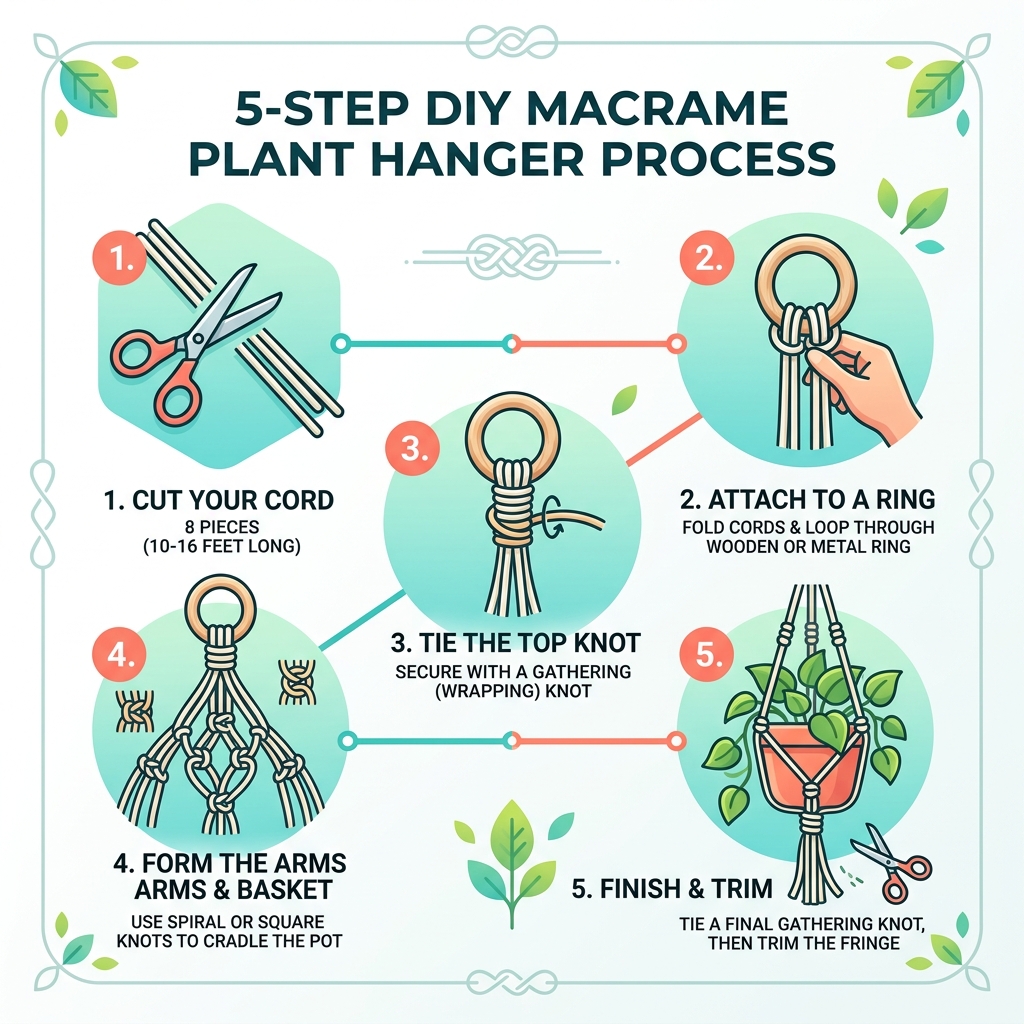
Here’s what you need to know at a glance:
- Cut your cord – 8 pieces of macrame cord, each about 10-16 feet long
- Attach to a ring – fold cords in half and loop through a 2-inch wooden or metal ring
- Tie the top knot – secure with a gathering (wrapping) knot below the ring
- Form the arms and basket – use spiral or square knots to cradle the pot
- Finish – tie a final gathering knot at the bottom and trim the fringe
You only need to learn three basic knots to complete this project. If you can measure and tie a knot, you can make one of these.
Macrame is also surprisingly relaxing. The repetitive motion of tying knots is therapeutic – many crafters describe it as meditative. And once you learn the basics here, those same skills carry over to wall hangings, garlands, and beyond.
One ball of 3mm cotton cord (under $10) can yield 6 or more finished hangers, making this one of the most budget-friendly DIY home decor projects around.
Essential Materials and Preparation
Before we dive into the knotting, we need to gather our supplies. One of the best things about macrame hanging planters diy is that you don’t need a workshop full of power tools. Most of these items are likely already in your junk drawer or available for a few dollars at a craft store.
The Shopping List
- Macrame Cord: This is the star of the show. We recommend 3mm or 4mm cotton cord. 3mm is excellent for standard indoor plants, while 4mm offers a chunkier, more structural look. A single 100-yard spool can often make up to 6 or 7 hangers!
- Rings: You can use wooden or metal rings. A 2-inch (50mm) diameter is standard. If you’re feeling extra “DIY,” you can even use a sturdy metal S-hook or create a “no-ring” loop out of the cord itself.
- Measuring Tape: Essential for ensuring your arms and basket sections are even.
- Sharp Scissors: Cotton cord can be surprisingly tough; you’ll want a clean cut to prevent fraying while you work.
- Decorative Beads: Optional, but wooden beads with large holes (10mm+) add a wonderful boho flair.
- S-Hook or Clothing Rack: To work comfortably, you’ll want to hang your project at eye level. An S-hook over a door frame or a portable clothing rack works perfectly.

When choosing your plant pot, macrame is flexible. However, for your first project, it helps to have a specific pot in mind. Check out our guide on the Best Pots for Indoor Plants to find the perfect match for your new hanger.
Cord Thickness vs. Pot Size
To help you plan, we’ve put together a quick reference for matching your materials to your greenery.
| Cord Thickness | Recommended Pot Diameter | Best For |
|---|---|---|
| 2mm | 3 – 4 inches | Succulents, Air Plants |
| 3mm | 5 – 7 inches | Pothos, Spider Plants |
| 4mm | 8 – 10 inches | Large Ferns, Monsteras |
| 5mm+ | 10+ inches | Heavy ceramic pots, Trees |
Choosing Supplies for Macrame Hanging Planters DIY
When selecting your cord, we almost always suggest 100% cotton 3-ply twisted cord. Why? It’s soft on the hands (no rope burn here!), it holds knots securely, and it creates that beautiful, brushed-out fringe we all love. Synthetic cords like nylon or polypropylene are durable for outdoor use but can be slippery and harder to knot tightly.
If you are a total beginner, don’t forget to brush up on your greenery knowledge with our Beginner Indoor Plant Care Guide so your plants stay as healthy as their new home is stylish.
Mastering the Fundamental Knots
Don’t let the word “macrame” intimidate you. It’s just a fancy word for tying knots in a specific sequence. For a standard macrame hanging planters diy project, you only need to master three main techniques: the Square Knot, the Spiral Knot (Half-Square Knot), and the Gathering Knot.
The Lark’s Head Knot
This is how you attach your cord to the ring.
- Fold your long cord in half.
- Push the folded loop through the center of the ring.
- Pull the two loose ends through the loop and tug tight.
The Square Knot
This is the “bread and butter” of macrame.
- Take a group of 4 cords. The two outer cords are your “working cords,” and the two inner cords are your “filler cords.”
- Cross the left cord over the fillers and under the right cord (forming a ‘4’ shape).
- Bring the right cord under the fillers and up through the loop on the left. Pull tight. (This is a half-square knot).
- Repeat the process starting from the right side. Cross the right cord over the fillers and under the left. Pull the left cord under the fillers and up through the loop.
The Spiral Half-Knot
Want that beautiful DNA-style twist? Simply repeat the first half of the Square Knot over and over again without alternating sides. If you always start from the left, the cord will naturally begin to spiral. About 24 half-knots will give you roughly 6 inches of gorgeous spiral texture.
Tying the Knots for Macrame Hanging Planters DIY
Consistency is key! We find that the most common mistake for beginners is tension. Try to pull each knot with the same amount of force. If you’re feeling creative, you can mix and match these. For instance, you might do 4 inches of spiral knots followed by 2 inches of straight square knots.
For more inspiration on small-scale fiber projects, take a look at our Easy Indoor Plant Crafts for more weekend ideas.
Step-by-Step Tutorial: Building Your Hanger
Now that you’ve practiced your knots, let’s build the actual hanger. We’ll be making a standard 30-to-38-inch hanger, which is the perfect size for most living rooms.
Step 1: Calculate and Cut
The golden rule of macrame is the 4x rule. Your cords should be four times the length of your finished project.
- For a 30-inch hanger, cut 8 pieces of cord, each 10 feet long.
- Cut one extra piece (about 2-3 feet) for your gathering knots.
Step 2: The Top Gathering Knot
Gather your 8 long cords, fold them in half over your ring, and secure them with a Lark’s Head knot (or just loop them through). You now have 16 strands hanging down. Use your extra short cord to tie a Gathering Knot (also called a wrapping knot) just below the ring. This creates a neat, professional-looking bundle that holds everything together.
Step 3: Creating the Arms
Divide your 16 strands into four groups of 4 cords each.
- Starting about 4-6 inches below the top knot, tie a series of knots on each group.
- You can choose to do 6 inches of Spiral Knots or Square Knots.
- Make sure all four arms are exactly the same length! Use your measuring tape to check.
Step 4: Forming the Basket Net
This is the section that actually holds the pot.
- Drop down about 4 inches from the bottom of your arms.
- Take 2 cords from one arm and 2 cords from the adjacent arm.
- Tie them together with a Square Knot.
- Repeat this all the way around until all arms are connected in a circle. This creates a “diamond” mesh.
- Drop down another 3 inches and repeat the process, alternating the cords again to create a second row of diamonds.
If you’re looking for more ways to hang your plants, check out our Indoor Hanging Plant DIY guide for alternative methods.
Finishing Your Macrame Hanging Planters DIY
The final step is to bring all 16 cords back together.
- Hold your pot inside the “net” you just made to ensure it fits snugly.
- Gather all the cords at the base of the pot and tie one final Gathering Knot.
- Trim the remaining cord to your desired length. Some people like a long, dramatic tassel, while others prefer a short, clean look.
- Pro Tip: Use a fine-tooth comb or a pet brush to brush out the cotton cord ends. This creates a soft, fluffy “fringe” that looks incredibly high-end.
For a unique twist, you can even use Recycled Planters for Houseplants like old jars or tins to go inside your new hanger.
Customization and Advanced Styling
Once you’ve nailed the basic macrame hanging planters diy, you’ll quickly realize how much room there is to make it your own. The core technique stays the same — you’re just playing with the details.
The easiest place to start is the finish. If you have cats (or just prefer a cleaner look), a no-tassel finish is a great option. Instead of leaving a long fringe at the bottom, weave the cord ends back up into the basket or tie small individual knots at each cord base. It gives the whole piece a more modern, minimal feel — and your cat will have to find something else to destroy.
Adding wooden beads is another simple way to level up your design. Slide them onto the two center filler cords of any square knot section, then tie a square knot directly underneath to lock the bead in place. That’s it! A small tip: wrap a bit of scotch tape around the cord end before threading — it acts like a makeshift needle and saves a lot of frustration.
If you’re feeling ready for a bigger challenge, try a double-tier design. You essentially repeat the basket section further down the same cords, which lets you hang two plants at different heights from a single ring. It’s a brilliant space-saver, especially in smaller rooms. Just plan ahead — you’ll need to start with much longer cords (around 20 feet rather than the standard 12).
Color-blocked cord is another fun option that requires zero extra skill. Simply knot together two different cord colors at the start, and the color change becomes part of the design. It’s bold, it’s easy, and it looks intentional even when it’s totally accidental.
For more ideas on how to style and display your finished hangers, our Indoor Plant Decoration Ideas guide shows you how to layer and arrange them for real visual impact.
Frequently Asked Questions about Macrame Plant Hangers
How long does it take to make a DIY macrame plant hanger?
For a complete beginner, your first project will likely take about 1 to 1.5 hours as you learn the knots. However, once you have the muscle memory down, a standard macrame hanging planters diy can be completed in just 30 minutes. It’s the perfect “nap time” or “after work” craft.
What size pot fits best in a standard macrame hanger?
Most DIY hangers are designed for 5-inch to 7-inch diameter pots. However, because the “basket” is a flexible net, it can often accommodate anything from a 4-inch succulent pot to a 10-inch hanging basket. The trick is to adjust the spacing between your mesh knots; wider spacing allows for larger pots. If you’re living in a tight space, check out our tips for Small Apartment Indoor Plants.
How do I calculate the correct cord length?
As a rule of thumb, use 4 times the desired finished length. If you want a 4-foot hanger, each cord should be 16 feet long. Every knot you tie “consumes” a bit of cord. A single half-square knot uses about 1 inch of cord. It is always better to have too much cord than to run out 2 inches from the bottom!
Conclusion
Creating your own macrame hanging planters diy is more than just a home decor project; it’s an entry into the wonderful world of fiber arts. At Financedora, we love DIY projects that are high-impact but low-cost. For under $5 and an hour of your time, you can transform a boring corner into a lush, boho sanctuary.
Whether you’re making these for yourself or as handmade gifts for friends, the satisfaction of saying “I made that” is unbeatable. Don’t stop here—there are endless patterns and styles to explore. Check out our DIY Category for more projects to keep your hands busy and your home beautiful. Happy knotting!
