
Do Succulents Clean the Air? Here’s What the Science Actually Says
Do succulents clean the air in your home? The short answer is yes — but with some important caveats.
Here’s a quick summary before we dive deeper:
- Succulents do remove toxins like formaldehyde, benzene, and xylene from indoor air
- The effect is real but modest — don’t expect a single plant to transform your air quality overnight
- Some varieties outperform others — Snake Plant and Aloe Vera are the top performers
- They release oxygen at night — unlike most plants, making them great for bedrooms
- You need multiple plants — NASA suggests at least one plant per 100 sq ft for a measurable difference
- Best used alongside good ventilation or a mechanical air purifier, not instead of them
Most people buy succulents because they’re gorgeous and nearly impossible to kill. But there’s a growing body of research suggesting these low-maintenance plants do something extra useful: they quietly filter the air around them.
The conversation really took off after NASA’s 1989 Clean Air Study found that certain indoor plants — including succulents — could remove a significant percentage of harmful volatile organic compounds (VOCs) from enclosed spaces. We spend up to 90% of our time indoors, where air can actually be more polluted than outside, so that finding matters.
Common household items like paint, cleaning products, and furniture constantly release low-level toxins into the air you breathe every day. Succulents absorb some of those toxins through their pores and root systems — and certain species are surprisingly effective at it.
This guide breaks down exactly how it works, which succulents do it best, and how to set them up for maximum effect in your home.
Do Succulents Clean the Air? The Science of Phytoremediation
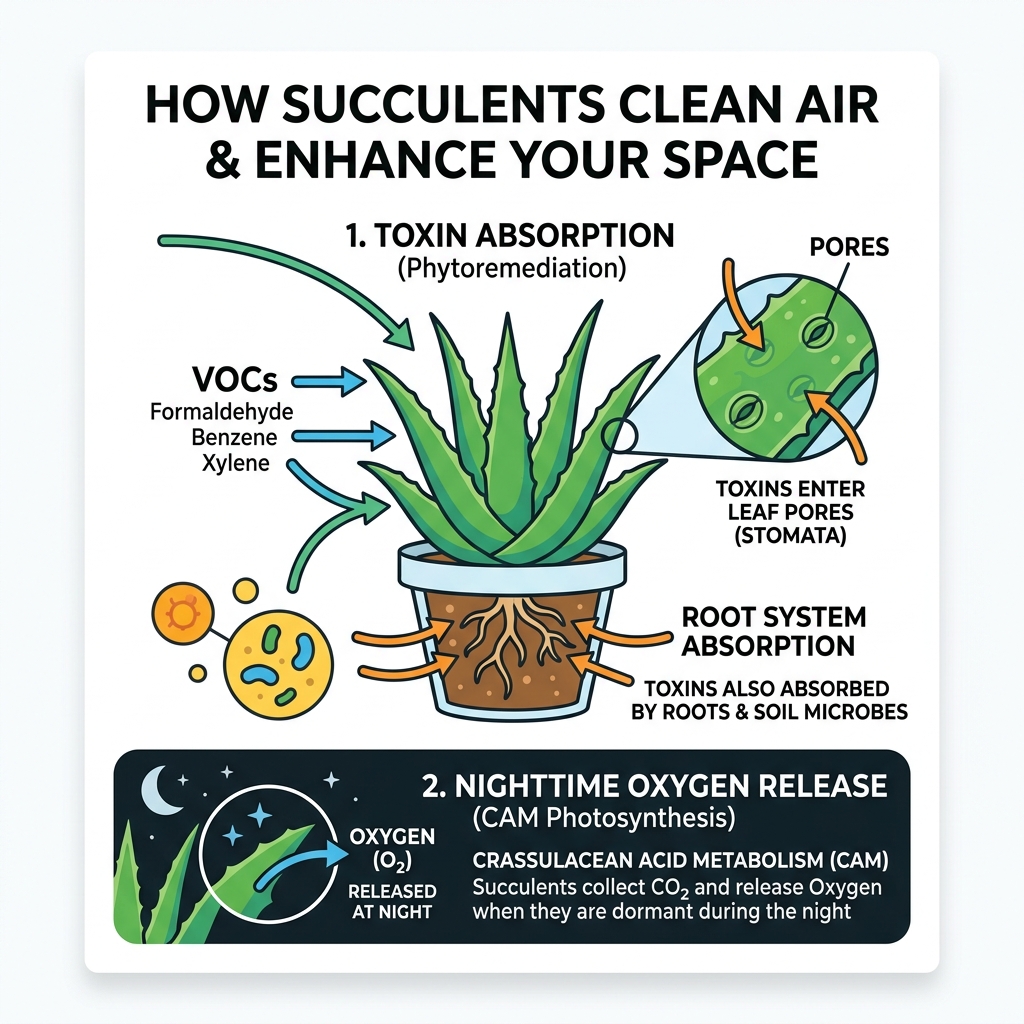
To understand how these desert-dwellers pull toxins out of the sky, we have to look at a process called phytoremediation. This is a fancy scientific term for when living plants clean up soil, air, or water. While many people think plants only “breathe” in carbon dioxide, they are actually much more complex biological filters.
When we ask, do succulents clean the air, we are really asking about their ability to mitigate Volatile Organic Compounds (VOCs). These are invisible gases emitted by everyday items. Formaldehyde can leak from your plywood bookshelf, benzene might drift in from your attached garage, and trichloroethylene often hides in household cleaners.
According to scientific research on succulent air purification, these plants don’t just trap these toxins on their leaves; they actually metabolize them. Some toxins are absorbed through the leaves, while others are pulled down into the root zone.
Interestingly, it isn’t just the plant doing the heavy lifting. The soil microbes living around the succulent’s roots play a massive role. These microorganisms break down the toxins into components the plant can use for food. If you’re looking for ways to purify indoor air naturally, understanding this plant-soil partnership is key. Succulents are among the many houseplants that remove toxins, though their methods are uniquely adapted to harsh, dry environments.
The 1989 NASA Clean Air Study
The gold standard for this topic is the 1989 NASA Clean Air Study, led by Dr. B.C. Wolverton. NASA was looking for ways to keep the air fresh for astronauts in cramped, airtight space stations. They placed various plants in sealed plexiglass chambers and pumped in high concentrations of VOCs.
The results were staggering: some plants removed up to 87% of toxins like benzene and formaldehyde within just 24 hours. This study proved that indoor plants that clean the air are a viable biological tool for filtration. However, our homes aren’t sealed plexiglass boxes. While the science is sound, the “real world” results in a drafty living room will be more subtle than in a NASA lab.
How Succulents Remove Toxins
Succulents have tiny openings on their leaves called stomata. Think of these as microscopic mouths. During the gas exchange process, the plant “inhales” air, which includes those pesky VOCs. Once inside, the plant uses its internal transport system to move these chemicals down to the roots.
This process of carbon sequestration and metabolic breakdown turns harmful pollutants into harmless organic acids and sugars. By utilizing plants for reducing indoor toxins, you are essentially installing a solar-powered, self-cleaning air filter that looks great on a coffee table.
Top Succulent Varieties for Indoor Air Quality
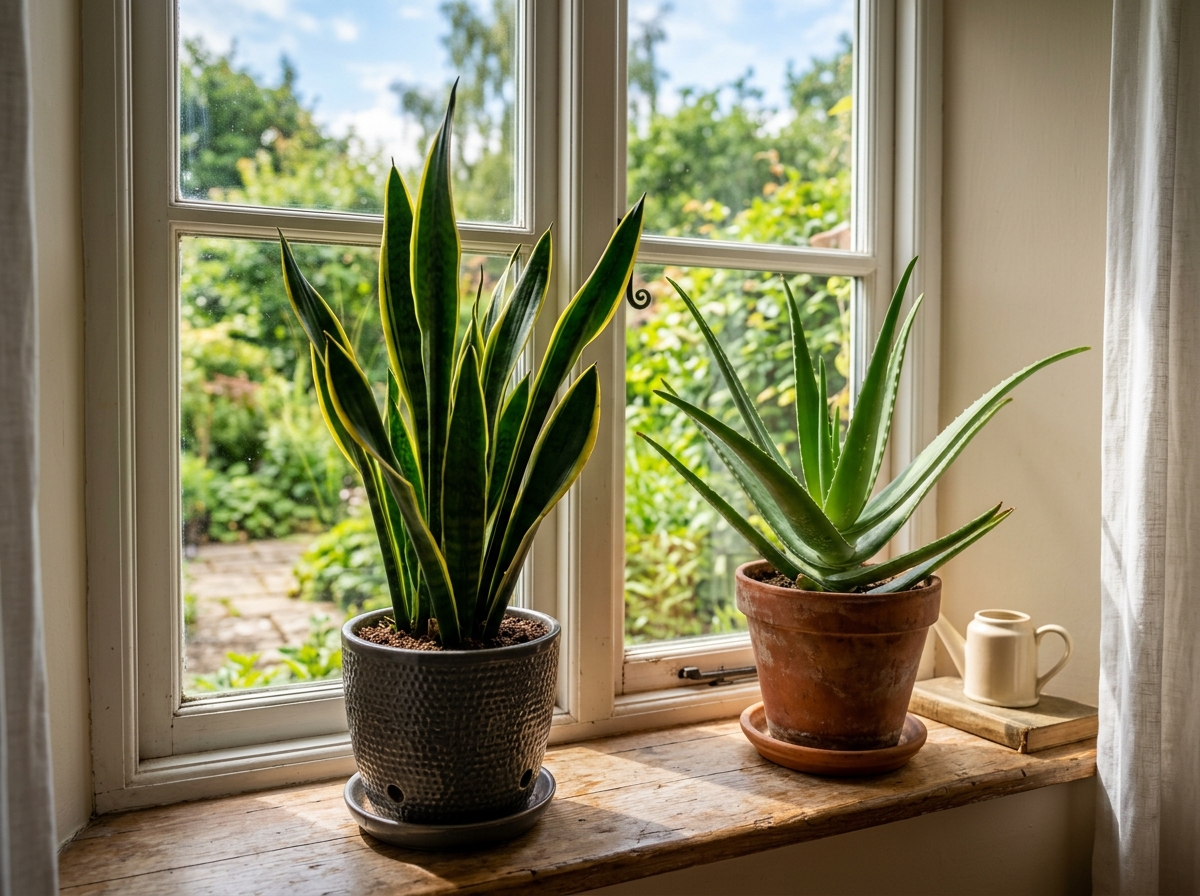
If you want to maximize your home’s “lung capacity,” you should choose your species wisely. Not all succulents are created equal when it comes to scrubbing the air. Here are the heavy hitters we recommend:
- Snake Plant (Sansevieria/Dracaena): Often called “Mother-in-Law’s Tongue,” this is the undisputed champion. It is incredibly hardy and excels at removing formaldehyde, nitrogen oxides, and xylene.
- Aloe Vera: This plant is a double threat. Not only does it heal your kitchen burns, but a single Aloe plant can remove up to 87% of formaldehyde from a small space in 24 hours.
- Jade Plant (Crassula ovata): Known for bringing “good luck,” it also brings good air by absorbing toluene (found in paints) and carbon dioxide during the day.
- Zebra Haworthia: A smaller option that fits perfectly on a desk, helping to filter formaldehyde and benzene in your immediate workspace.
- Christmas Cactus: A beautiful bloomer that works hard to improve air freshness while tolerating slightly more humidity than its desert cousins.
For those just starting out, air-cleaning succulents like the Snake Plant are perfect because they are low-water air-purifying plants that thrive even if you forget about them for a few weeks.
Why Do Succulents Clean the Air at Night?
Most houseplants are “C3” plants, meaning they take in CO2 and release oxygen during the day while the sun is out. At night, they actually switch and consume a little oxygen. Succulents are different. Many use a special process called Crassulacean Acid Metabolism (CAM).
Because they evolved in hot, arid climates, succulents keep their stomata closed during the day to prevent water loss. They only open their “pores” at night when it’s cooler. This means they absorb carbon dioxide and release fresh oxygen while you sleep. This unique trait makes succulents some of the top air-purifying plants for bedroom use, as they actively refresh the air during your eight hours of shut-eye.
Best Succulents for Specific Pollutants
According to the guide Breathe Easier with Succulents: Do They Really Purify the Air?, different plants have different “specialties.”
- Xylene Removal: The Snake Plant is particularly good at filtering xylene, which is often found in printing, rubber, and leather industries (and some household cleaners).
- Toluene Filtration: Jade plants are effective at reducing toluene, a common solvent in paints and nail polishes.
- Ammonia Reduction: While not a succulent, the Peace Lily is often grouped with them in best-plants-for-air-quality lists for its ability to tackle ammonia from window cleaners.
Maximizing Benefits: Placement and Care Tips
To get the most out of your green air filters, you need to keep them healthy. A dying plant isn’t doing much cleaning! Succulents need bright, indirect light and a well-draining soil mix (look for “cactus mix” at the store).
One of the best things succulents do for air quality is improve humidity. Through a process called transpiration, they pull water from their roots and release it as vapor through their leaves. This acts as a natural humidifier, which can help prevent dry skin and sore throats during the winter. Using decorative air-purifying plants is a stylish way to keep your home’s “microclimate” comfortable. Because they are hardy air-purifying plants, they can handle the dry air of modern heating systems better than most.
Strategic Placement for Better Breathing
- The Bedroom: Place a Snake Plant or Aloe Vera here. Since they release oxygen at night, they help you breathe easier while you sleep.
- The Kitchen: Aloe Vera is perfect for a kitchen windowsill. It filters toxins from cleaning products and is right there if you accidentally touch a hot pan.
- The Home Office: A Zebra Haworthia or Jade plant on your desk can help reduce CO2 levels, which some studies suggest helps improve focus and reduce “brain fog.”
Creating air-purifying plant arrangements by grouping several succulents together can actually increase their effectiveness by creating a concentrated zone of filtered air.
How Many Succulents Do You Need to Clean the Air?
This is where the “caveat” comes in. One tiny 2-inch succulent isn’t going to fix the air in a 500-square-foot studio. To see a measurable difference in toxin levels, NASA research suggests a plant density of about 10 to 12 medium-sized plants (in 8-10 inch pots) per 100 square feet.
If you have a typical 10×10 bedroom, that’s a lot of plants! However, even a few small air-cleaning houseplants can improve the air quality in your immediate “breathing zone”—like right next to your pillow or your computer screen.
Succulents vs. Mechanical Air Purifiers
We love our plants, but we have to be honest: they aren’t machines. If you have severe allergies or live in a high-smog area, you shouldn’t rely only on a Jade plant.
| Feature | Succulents | HEPA Air Purifier |
|---|---|---|
| Particle Capture | Low (some dust on leaves) | High (99.97% of dust/pollen) |
| VOC Removal | Moderate (Passive) | High (Active Carbon Filters) |
| Energy Use | Zero (Solar powered!) | Requires Electricity |
| Aesthetic Value | High (Beautiful & Natural) | Low (Usually a plastic box) |
| Maintenance | Watering & Light | Filter Replacements |
| Noise Level | Silent | Fan Noise |
The best approach is a holistic one. Use a mechanical purifier to handle the heavy lifting of dust and pollen, and use air-purification-benefits-of-houseplants to handle trace VOCs and boost your mood.
Frequently Asked Questions about Succulent Air Purification
Can succulents replace a HEPA air purifier?
In short, no. A HEPA (High-Efficiency Particulate Air) filter is designed to move massive amounts of air through a dense filter to catch tiny particles like smoke and dander. Succulents work passively and much more slowly. Think of the purifier as a vacuum cleaner and the succulents as a slow-acting “air sponge.” They are great budget-friendly air-cleaning plants, but they work best as a supplement to mechanical filtration.
Are air-purifying succulents safe for pets?
This is a very important question! Some of the best air cleaners are actually toxic if your cat or dog decides to have a snack.
- Safe (Non-Toxic): Christmas Cactus, Haworthia (Zebra Plant), and Burro’s Tail are generally pet-friendly.
- Toxic: Snake Plants, Aloe Vera, and Jade Plants can cause tummy upset or more serious issues for pets. Always check the ASPCA database and consider non-toxic air-purifying plants if you have a curious furry friend.
Which succulent releases the most oxygen?
The Snake Plant is widely considered the winner here. Because of its large leaf surface area and its efficient CAM photosynthesis, it is a powerhouse for nighttime respiration. If you want to purify indoor air naturally and improve your sleep quality, the Snake Plant is your best bet.
Conclusion
At Financedora, we believe that your home should be a sanctuary. While the question do succulents clean the air has a nuanced answer, there is no denying the benefits they bring. Even if you don’t have enough plants to match NASA’s laboratory conditions, adding greenery to your space is a proven way to boost mental wellbeing, reduce stress, and add a touch of sustainable living to your decor.
Whether you’re looking to scrub away kitchen toxins or just want a “breathing companion” for your nightstand, succulents are a beautiful, low-impact solution. Ready to start your indoor garden? Check out our other guides at https://financedora.com/ to learn more about creating a healthy, happy home.
