
Why the Best Plants for Air Quality Matter More Than You Think
The best plants for air quality aren’t just decoration — they’re one of the simplest ways to reduce the toxic chemicals you breathe every day at home.
Here’s a quick look at the top picks:
| Plant | Key Pollutants Removed | Pet Safe? | Light Needs |
|---|---|---|---|
| Snake Plant | Benzene, formaldehyde, trichloroethylene | No | Low to bright indirect |
| Spider Plant | Formaldehyde, carbon monoxide | Yes | Indirect light |
| Peace Lily | Mold spores, alcohols, acetone | No | Low to medium |
| English Ivy | Mold, xylene, allergens | No | Indirect light |
| Golden Pothos | Benzene, toluene, ozone | No | Low to bright indirect |
| Bamboo Palm | Formaldehyde, trichloroethylene | Yes | Bright indirect |
| Chrysanthemum | Ammonia, benzene | No | Bright light |
| Rubber Plant | Formaldehyde, mold spores | No | Bright indirect |
| Aloe Vera | Benzene, formaldehyde | No | Bright, sunny |
| ZZ Plant | Toluene, xylene | No | Low to bright indirect |
Most people spend around 90% of their time indoors. And indoor air can actually be more polluted than outdoor air — sometimes up to five times worse.
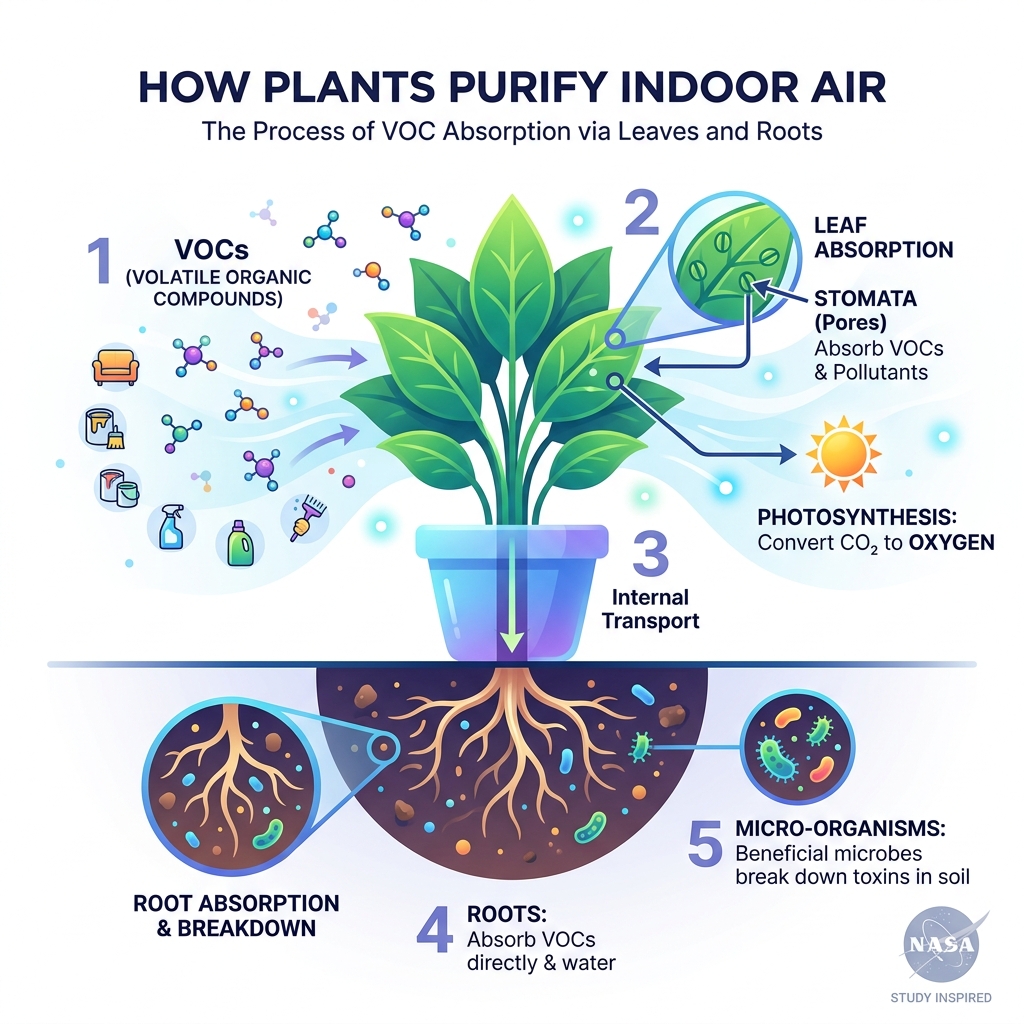
The culprits? Everyday items like furniture, paint, and cleaning products release invisible chemicals called Volatile Organic Compounds (VOCs). These include formaldehyde, benzene, and trichloroethylene — all linked to headaches, respiratory issues, and worse.
The good news: certain houseplants can pull these toxins right out of the air. NASA studied this extensively, finding that common indoor plants absorb harmful chemicals through their leaves and root systems in a process called phytoremediation. The microorganisms living in the soil around plant roots help break down toxins too.
The right plants can make a real, measurable difference — especially in tightly sealed modern homes where fresh air doesn’t circulate freely.
The Science Behind the Best Plants for Air Quality
When we talk about the best plants for air quality, we are standing on the shoulders of giants—specifically, the scientists at NASA. In 1989, NASA teamed up with the Associated Landscape Contractors of America to conduct the “Clean Air Study.” Led by Dr. Bill Wolverton, the research aimed to find ways to purify the air in space stations. Since space stations are essentially airtight tin cans, the buildup of toxic chemicals was a major concern.
What they discovered changed the way we look at our living rooms. They found that common houseplants are remarkably efficient at filtering out specific toxins. These chemicals, often referred to as the “Big Five,” include:
- Benzene: Found in plastics, resins, synthetic fibers, and detergents.
- Formaldehyde: Common in paper bags, facial tissues, and particleboard.
- Trichloroethylene: Used in printing inks, paints, and lacquers.
- Xylene: Found in rubber, leather, and tobacco smoke.
- Ammonia: Used in window cleaners and floor waxes.
According to the NASA compiles list of best plants to clean indoor air, these plants don’t just sit there looking pretty; they act as biological filters. Through their leaves and roots, they absorb these pollutants and convert them into food for themselves and the beneficial bacteria in their soil. This is part of the broader air-purification-benefits-of-houseplants that we can all enjoy in our own homes. By strategically choosing plants-for-reducing-indoor-toxins, we can significantly lower the chemical burden on our bodies.
10 Best Plants for Air Quality and How to Care for Them
Choosing the right greenery involves more than just picking what looks good on a shelf. To get the most out of your indoor garden, you need to match the plant’s needs with your home’s environment. Whether you have a sun-drenched sunroom or a dim office corner, there is a perfect match for you.

When we look at the 21 Best Air-Purifying Indoor Plants (NASA-Tested for Cleaner Air) 2025 edition, it’s clear that variety is key. Different plants target different toxins, so a diverse “indoor jungle” is the most effective approach. For those just starting, indoor-plants-that-clean-the-air provide a natural, low-cost way to boost well-being.
Snake Plant: The Best Plants for Air Quality in Bedrooms
The Snake Plant (Dracaena trifasciata), also humorously known as “Mother-in-Law’s Tongue,” is arguably the king of the best plants for air quality. What makes it unique is its nighttime behavior. While most plants take in CO2 and release oxygen during the day, the Snake Plant uses Crassulacean Acid Metabolism (CAM) to release oxygen at night. This makes it one of the top-air-purifying-plants-for-bedroom settings, potentially helping you sleep better.
Research from the Snake plant – Dracaena trifasciata | Kew highlights its incredible resilience. It can naturally decrease detectable VOCs by up to 87 percent within a 24-hour window.
- Care: It is almost impossible to kill. It thrives in low to bright indirect light and only needs water every 2–8 weeks when the soil is bone dry.
- Pollutants Removed: Benzene, formaldehyde, trichloroethylene, xylene, and toluene.
Spider Plant: The Low-Maintenance Filter
If you’re a self-proclaimed “black thumb,” the Spider Plant is your new best friend. It is considered a cheerful superstar in the plant world because of its ability to produce “pups” (baby plants) that you can easily propagate. It’s one of the most effective small-air-cleaning-houseplants available.
Studies show that a single spider plant in a 200-square-foot room is enough to act as an effective air filter. It can eliminate up to 95% of harmful chemicals, including carbon monoxide and formaldehyde, within just 24 hours.
- Care: Prefers bright, indirect light but will tolerate lower light. Water when the top inch of soil feels dry.
- Pollutants Removed: Formaldehyde, xylene, and carbon monoxide.
Peace Lily: The Flowering Purifier
The Peace Lily is more than just a beautiful white bloom; it is a heavy-duty air scrubber. It is one of the few flowery-air-purifying-plants that can significantly reduce the levels of mold spores in the air by absorbing them through its leaves and circulating them to its roots to use as food.
- Care: They enjoy medium to low light. They are excellent communicators—they will literally droop their leaves when they are thirsty, making them great for beginners.
- Pollutants Removed: Ammonia, benzene, formaldehyde, trichloroethylene, alcohols, and acetone.
English Ivy: The Allergen Combatant
English Ivy is a “hardy” choice for those looking to tackle specific airborne irritants. It has been shown to put the “smackdown” on mold and even fecal particles, making it an ideal choice for bathrooms or laundry rooms. As one of the hardy-air-purifying-plants, it is particularly good at filtering out xylene.
- Care: It likes constant moisture and four hours of direct sunlight a day, though it can thrive in indirect light too.
- Pollutants Removed: Benzene, formaldehyde, xylene, toluene, and airborne mold.
Golden Pothos: The Indestructible Vine
Often called “Devil’s Ivy” because it’s so hard to kill, the Golden Pothos is a beginner’s dream. It’s a fast-growing vine that looks great in hanging baskets. It is highly effective at removing ozone, which can accumulate from office equipment, making it one of the low-light-air-purifying-plants we recommend for windowless rooms.
- Care: Very forgiving. It can survive in low light and irregular watering.
- Pollutants Removed: Benzene, toluene, formaldehyde, and carbon monoxide.
Bamboo Palm: The Natural Humidifier
The Bamboo Palm (Chamaedorea seifrizii) brings a bit of tropical-air-purifying-plants flair to any space. Beyond removing chemicals like formaldehyde and trichloroethylene, it acts as a natural humidifier, pumping moisture back into the air—a huge benefit during dry winter months.
- Care: It prefers bright, indirect light and likes to stay relatively moist (but not soggy).
- Pollutants Removed: Formaldehyde, benzene, trichloroethylene, and xylene.
Chrysanthemum: The Heavy-Duty Cleaner
When it comes to pure cleaning power, the Florist’s Chrysanthemum is ranked as one of the best by NASA. It is a houseplants-that-remove-toxins powerhouse, capable of removing ammonia and benzene simultaneously.
- Care: This is a seasonal cleaner. It only purifies the air while it is in bloom (roughly six weeks). It needs bright, indirect sunlight and plenty of water.
- Pollutants Removed: Ammonia, benzene, formaldehyde, and xylene.
Rubber Plant: The Toxin Buster
With its large, waxy leaves, the Rubber Plant (Ficus elastica) is built for absorption. Its massive leaf surface area makes it a decorative-air-purifying-plants choice that doubles as a serious toxin buster. It is particularly good at clearing out formaldehyde from carpets and furniture.
- Care: Needs bright, filtered light. Wipe the leaves with a damp cloth occasionally to keep the “pores” (stomata) clear of dust so the plant can breathe.
- Pollutants Removed: Formaldehyde and mold spores.
Aloe Vera: The Medicinal Succulent
We all know Aloe Vera for its ability to soothe burns, but it’s also one of the air-cleaning-succulents you should have in your kitchen. It’s excellent at monitoring air quality; if you see brown spots forming on the leaves, it may be a sign that the air is heavily polluted with chemicals.
- Care: Needs a sunny spot. Being a succulent, it is very drought-tolerant and prefers to dry out between waterings.
- Pollutants Removed: Benzene and formaldehyde.
ZZ Plant: The Office Favorite
The ZZ Plant is the ultimate office-air-purifying-plants choice. It’s tough, beautiful, and can survive in the windowless corners of a cubicle. It is specifically effective at removing toluene and xylene from the air.
- Care: Thrives on neglect. It can go weeks without water and survives in very low light.
- Pollutants Removed: Benzene, toluene, ethylbenzene, and xylene.
Maximizing Air Purification in Your Home
To truly purify-indoor-air-naturally, you can’t just buy one small cactus and call it a day. The volume of plants matters. Research suggests that for a typical 1,800-square-foot house, you should incorporate 15 to 18 houseplants in 6- to 8-inch diameter containers to see a significant improvement in air quality.
| Room Size (Sq Ft) | Recommended Number of Plants | Best Placement |
|---|---|---|
| 100 | 2 Medium Plants | Near the window or desk |
| 500 | 5-8 Plants | Grouped in corners for a “mini-jungle” |
| 1,000 | 10-12 Plants | Spread across living and sleeping areas |
| 1,800 | 15-18 Plants | Distributed throughout the home |
When creating air-purifying-plant-arrangements, grouping plants together can actually increase the local humidity and improve the filtration rate. Also, don’t forget the “leaf cleaning” rule! Dust on leaves blocks the plant’s ability to absorb toxins. A quick wipe once a month keeps your green filters running at 100% efficiency.
Safety and Limitations of Indoor Greenery
While we love our leafy friends, we have to be realistic. In a real-world home, plants are not as efficient as a high-powered HEPA air purifier. Air purifiers can remove up to 99.97% of airborne particles, something plants simply can’t match. For the best results, we recommend a combined approach: use plants for VOC removal and a mechanical purifier for dust and pollen.
Safety is also paramount. Many of the best plants for air quality contain saponins or calcium oxalate crystals, which are toxic if ingested. According to the Snake Plant: Benefits, Types, Cautions, and How to Grow, you must keep plants like the Peace Lily and English Ivy out of reach of curious pets and toddlers.
If you have furry friends, focus on non-toxic-air-purifying-plants like the Spider Plant, Bamboo Palm, or Boston Fern. Always check the ASPCA database if you are unsure about a new addition to your home.
Frequently Asked Questions about Indoor Air Quality
How many of the best plants for air quality do I need per room?
For a noticeable effect, aim for at least two medium-sized plants (in 6-inch pots) for every 100 square feet of living space. If you are trying to purify-indoor-air-naturally-2, larger, leafier plants have more surface area and therefore filter more air than smaller succulents.
Do plants work better than mechanical air purifiers?
They work differently. Mechanical purifiers with HEPA filters are superior at removing physical particles like dust, pet dander, and smoke. Plants are better at absorbing gaseous pollutants (VOCs) and improving humidity and mental health. A combined approach is the gold standard for home health.
Which plants are safest for homes with pets and children?
The “big three” safe plants are the Spider Plant, Bamboo Palm, and Boston Fern. These are non-toxic and highly effective at removing formaldehyde and other toxins without posing a risk to your family.
Conclusion
At Financedora, we believe that a healthy home is the foundation of a prosperous life. Investing in the best plants for air quality is a low-cost, high-reward strategy for sustainable living. Not only do these plants clean the air, but they also reduce stress, boost productivity by up to 20%, and can even lower energy costs by reducing the need for heavy ventilation.
Whether you start with a single “indestructible” Snake Plant in your bedroom or create a lush tropical sanctuary in your living room, your lungs will thank you. Ready to breathe easier? Start improving your home environment today and let nature do the heavy lifting for your indoor air quality.
